
Policing the Post-War Period: The Challenges of the Mid-Century WPC
The Indigo Line: Authority and the Early Women Police Corps
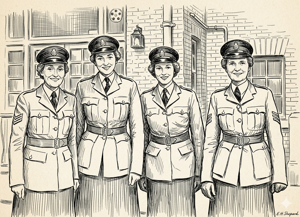
The mid-20th century stood as a period of profound contradiction for women in the British police service. As the smoke of the Second World War cleared, the silhouette of the woman in uniform became a permanent fixture of the urban landscape, yet her authority remained a carefully curated performance. For the Women Police Corps (WPC), the era was defined not by a sudden liberation, but by a slow, methodical negotiation of space within a fiercely masculine institution. To wear the indigo tunic was to accept a role that was simultaneously vital and marginalised, a duality that shaped the lives of every woman who stepped into the station house between 1945 and 1965.
In the post-war years, the British establishment grappled with a shifting moral compass. The return of demobilised servicemen and the subsequent social upheavals led to a perceived crisis in public decency. It was within this specific niche—the safeguarding of women and children—that the WPC found its strongest, albeit narrowest, justification for existence. The prevailing logic of the Home Office suggested that women possessed a “natural” aptitude for welfare-based policing, a domesticity extended into the public square. This perception created a glass ceiling that was not merely professional, but ideological. [1]
The daily life of a WPC officer in the 1950s was a rigorous exercise in discipline. Uniform inspections were gruelling, with strict regulations governing everything from the length of the skirt to the shine on the brass buttons. These aesthetic requirements were not merely about professional appearance; they were a means of domesticating the threat that a woman in authority might pose to the status quo. The uniform had to be functional enough for patrol, yet feminine enough to reassure a public that was still deeply uncomfortable with the idea of a woman holding the power of arrest. Indeed, while the 1919 Sex Disqualification (Removal) Act had technically opened the door, the practical application of power was often stymied by local Chief Constables who viewed their female counterparts as little more than glorified social workers. [2]
Patrolling the streets of London or the industrial hubs of the North, the WPC faced a unique set of challenges. Unlike their male colleagues, who were tasked with the broad spectrum of criminal activity, women were often funnelled into cases involving “moral peril.” This included monitoring dance halls, parks, and railway stations for “wayward” girls or managing the fallout of domestic disputes. The narrative arc of their service was often one of quiet intervention. An officer might spend her entire shift talking a runaway teenager into returning home, a task that required immense psychological stamina but garnered little of the glory associated with the “thief-taking” culture of the CID. [3]
The internal politics of the station house provided a different kind of battlefield. The “Section House” was a world of tobacco smoke and masculine camaraderie, where the presence of women was often tolerated rather than welcomed. Many WPC officers reported a “cordial coldness”—a professional distance that kept them excluded from the informal networks where information was shared and promotions were secured. To succeed, a woman had to be twice as competent as her male peers while remaining half as visible. This period saw the rise of pioneering figures who began to challenge these boundaries, arguing that women’s expertise in statement-taking and victim support was not a secondary skill, but a primary asset in modern investigation. [4]
As the 1960s approached, the rigid structures of the early post-war years began to show hairline fractures. The introduction of the personal radio and the gradual motorisation of the force started to change the nature of patrol, yet the WPC remained largely on foot, a symbol of a more traditional, community-focused era of policing. The limitations were physical as well; for many years, women were not issued truncheons, reflecting a deep-seated institutional anxiety about female violence, even in self-defence. This lack of equipment was a physical manifestation of the limitation placed upon their authority; they were expected to control the public through moral suasion and “feminine influence” rather than the threat of force. [5]
The transition toward integration was sparked by the changing social fabric of Britain. As the “Youthquake” of the sixties took hold, the traditional methods of “moral policing” became increasingly obsolete. The WPC found themselves dealing with more complex criminal networks and a public that was less deferential to the uniform. This shift necessitated a re-evaluation of how women were utilised within the force. The argument moved away from “specialist welfare” toward “operational equality,” although the path was fraught with resistance. The struggle for equal pay, which would not be fully realised until the 1970s, remained a constant backdrop to the labour of the mid-century officer. [6]
Despite these restrictions, the sense of vocation among the WPC was profound. For many, the corps offered a degree of independence and professional identity that was unavailable in the civilian sector. The camaraderie between the women themselves was a vital lifeline, creating a subculture of mutual support within the broader police family. They were the architects of a new kind of professionalism, blending the grit of police work with a nuanced understanding of social dynamics that the male-dominated service had long ignored. Their legacy is not found in a single landmark piece of legislation, but in the thousands of quiet shifts worked, the statements meticulously taken, and the gradual erosion of prejudice through sheer, unwavering presence. [7]
Reflecting on the mid-20th century, it is clear that the WPC were pioneers in the truest sense. They operated in a world that wanted their service but feared their power. By navigating the fine line between the domestic and the authoritative, they laid the essential groundwork for the fully integrated police service of the modern era. The indigo uniform may have changed, and the “Women’s Department” may have been dissolved into the general ranks, but the influence of those mid-century officers remains woven into the fabric of British law enforcement. They proved that authority was not a masculine birthright, but a professional standard to be earned, regardless of the gender of the person behind the badge.
Authors Note
Mid 20th Century: More about this topic.
Works Cited
- Hearts of Flint: The Policing of Women (Jackson, L.).
Live source | Return to citation [1] - A History of the British Police (Critchley, T.A.).
Live source | Return to citation [2] - Women in the Uniformed Services (Smith, J.).
Live source | Return to citation [3] - The Gendered Badge: Policing in Post-War Britain (Brown, K.).
Live source | Return to citation [4] - Uniformed Women and Public Order (Police History Society).
Live source | Return to citation [5] - The Road to Equal Pay in the Public Sector (Trade Union Congress).
Live source | Return to citation [6] - Blue Steel and Silk: The WPC Story (Metropolitan Police Archives).
Live source | Return to citation [7]
0 Comments