
Victorian Obsession with Death and the Rise of Spiritualism
How grief, high mortality, and scientific upheaval shaped a culture determined to speak with the dead
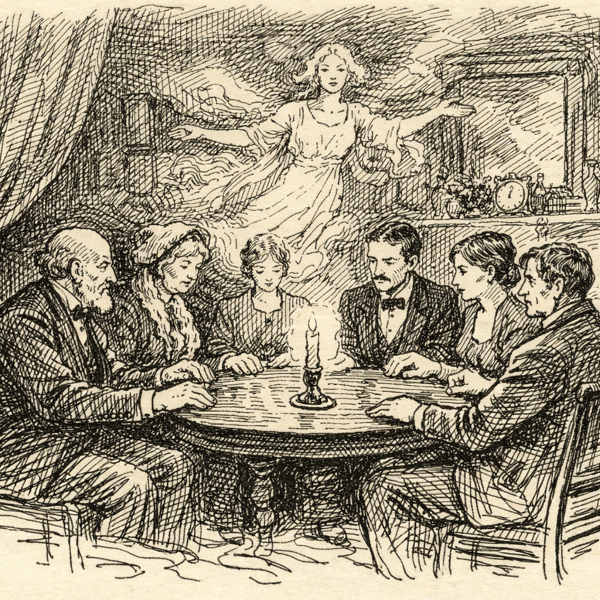
In the dim glow of a parlour lamp, a table trembles. Hands rest lightly upon polished wood, fingers touching, breath held. A widow listens for a knock from the other side. In Victorian Britain and America, this was not an unusual scene. It was an attempt, earnest and often desperate, to bridge the distance between the living and the dead.
The nineteenth century was saturated with death. Epidemics swept cities, industrial accidents scarred families, and childhood illness was common. Grief was not hidden. It was worn in black crepe, pressed into lockets of hair, captured in photographs of still faces posed as if merely asleep. Out of this landscape of loss emerged a movement that promised comfort and continuity: spiritualism.
What began as a set of strange sounds in a modest New York home in 1848 grew into an international phenomenon. Séances, spirit photography, automatic writing, and talking boards offered Victorians something both ancient and modern, a ritual of mourning shaped by new technologies and new anxieties.
High Mortality and the Culture of Public Grief
To understand Victorian spiritualism, one must begin with statistics that translate into heartbreak. In the mid nineteenth century, child mortality rates in Britain and the United States were dramatically higher than today. In some regions, roughly one in four children died before the age of five.[1] Infectious diseases such as scarlet fever, diphtheria, and tuberculosis cut through families with little warning.
Death was therefore intimate and familiar. It took place at home, not behind hospital doors. The rituals that followed were elaborate and public. The Victoria and Albert Museum notes that mourning dress in the nineteenth century was governed by strict codes, especially for widows, who could spend years in prescribed stages of black attire.[2] Mourning jewellery, often containing woven hair of the deceased, served as a portable relic, a way to keep the lost physically near.
Photography intensified this impulse. The invention of the daguerreotype in 1839 allowed families to capture images of loved ones who might never otherwise have been formally portrayed. Post mortem photography, in which the deceased were arranged to appear peacefully at rest, became a documented practice.[3] The camera preserved the body’s likeness, even as decay made its quiet claim.
In such a culture, longing for further contact did not seem irrational. It felt like an extension of existing devotion.
The Fox Sisters and the Birth of Modern Spiritualism
The spark that ignited modern spiritualism came in 1848 in Hydesville, New York. Two young sisters, Margaret and Kate Fox, claimed that mysterious rapping sounds in their home were communications from a spirit. They developed a code, one knock for yes, two for no. News of the “Rochester Rappings” spread rapidly through newspapers and public demonstrations.[4]
Within a few years, séances were being held across the United States and Britain. Mediums, often women, entered trance states and relayed messages from the dead. The movement offered a striking social shift. At a time when women were excluded from most public platforms, the séance room granted them authority as conduits of unseen knowledge.
The movement also crossed the Atlantic quickly. By the 1850s and 1860s, spiritualist societies and circles had formed throughout Britain. The practice was not confined to the uneducated. It attracted lawyers, writers, scientists, and clergymen, many of whom sought to test rather than merely accept the phenomena.
Science, Doubt, and the Society for Psychical Research
Victorian spiritualism unfolded in the shadow of scientific upheaval. Charles Darwin’s “On the Origin of Species” in 1859 unsettled traditional readings of creation and humanity’s place in the cosmos. Advances in geology and biblical criticism challenged literal interpretations of scripture. For some, spiritualism offered a middle path, a way to reconcile empirical curiosity with belief in an afterlife.
In 1882, the Society for Psychical Research was founded in London to investigate claims of telepathy, apparitions, and mediumship using systematic methods.[5] Its members included prominent intellectuals such as Henry Sidgwick and Frederic Myers. They documented cases, interviewed witnesses, and attempted to separate fraud from genuine anomaly.
This impulse to investigate rather than simply denounce reflected the era’s mindset. If electricity could carry voices across wires, why could not some subtler force carry thoughts beyond the grave? Even scepticism was shaped by the language of experiment and evidence.
Queen Victoria and the Legitimising of Mourning
When Prince Albert died in 1861, Queen Victoria entered a prolonged period of mourning that would define her public image. She wore black for the remainder of her life and maintained Albert’s rooms as if he might return.[6] Her grief was not private but national, woven into the identity of the age.
Although Victoria’s involvement with formal séances remains debated, she did show interest in mediums, particularly through figures such as John Brown and others who were believed to offer comfort after Albert’s death.[7] The royal example reinforced the legitimacy of sustained mourning and helped normalise the search for consolation beyond orthodox church structures.
If the monarch herself refused to “move on,” then the yearning of ordinary widows seemed less eccentric and more human.
Technologies of the Unseen
Victorian spiritualism thrived on spectacle. Séances featured tipping tables, spirit trumpets that amplified ghostly whispers, and cabinets in which mediums materialised ectoplasmic forms. Some of these effects were later exposed as deliberate trickery, using hidden assistants or clever stagecraft.
Spirit photography became one of the most controversial tools. Photographers such as William H. Mumler in the United States produced images in which faint, translucent figures appeared beside living sitters. Investigations later demonstrated how double exposure techniques could create such apparitions, yet clients often remained convinced of their authenticity.[8]
The talking board, later trademarked as the Ouija board, emerged in the late nineteenth century as a more accessible means of contact. Marketed as both entertainment and spiritual instrument, it reflected the commercialisation of the unseen.[9] Communication with the dead moved from private parlour to boxed product.
Famous Believers and Public Debate
Spiritualism’s credibility was shaped in part by high profile supporters. Sir Arthur Conan Doyle, creator of Sherlock Holmes, became one of the movement’s most ardent advocates in the early twentieth century. He lectured widely and defended mediums even after repeated exposures of fraud.[10] For Doyle, spiritualism was not superstition but a new revelation.
Thomas Edison also expressed interest in the possibility of building a device capable of detecting personality after death, though no such machine materialised. His comments reveal how technological optimism could blur into metaphysical speculation.[11]
At the same time, magicians such as Harry Houdini dedicated themselves to debunking fraudulent mediums. Public demonstrations exposed hidden wires, concealed accomplices, and muslin “spirits.” The movement was therefore both belief and battleground, faith and performance.
Psychology, Consolation, and the Persistence of Hope
From a psychological perspective, spiritualism can be read as a coping mechanism shaped by cultural context. Modern grief studies suggest that maintaining continuing bonds with the deceased is a common and often healthy response to loss. The Victorians enacted this through ritual, material culture, and narrative.
Spiritualism provided a script in which death was not annihilation but transition. It allowed mourners to ask questions, to apologise, to seek reassurance. Even when séances were fraudulent, the emotional exchange could feel real. The message, however contrived, affirmed that love persisted.
The movement also reflected deeper tensions. Industrialisation transformed landscapes and labour. Urbanisation disrupted traditional community structures. Scientific advances destabilised inherited certainties. In such a climate, the séance circle offered order. Participants sat in a ring, hands joined, awaiting a pattern of knocks that promised meaning.
Legacy of a Haunted Century
By the early twentieth century, repeated exposures of fraudulent mediums eroded public trust. Yet spiritualism did not vanish. It adapted, influencing later New Age movements, paranormal research, and popular culture. Ghost stories flourished in Victorian and Edwardian literature, embedding the era’s anxieties into enduring narrative forms.
The Victorian obsession with death was not mere morbidity. It was a response to lived reality. High mortality rates, visible grief, and rapid intellectual change created a society acutely aware of life’s fragility. Spiritualism emerged at that crossroads, shaped by both heartbreak and hope.
In the quiet of the séance room, amid the creak of wood and the hush of expectation, the Victorians rehearsed a question that has never fully left us. Is death an ending, or a threshold? Their answer was not uniform, nor always honest, but it was deeply human. In seeking the dead, they revealed how fiercely the living wish to remain connected.
Victorian Category: More about this topic.
Works Cited
-
Child Mortality, Our World in Data.
Provides historical data on child mortality rates, illustrating the scale of loss in the nineteenth century.
Live source | Return to citation [1] -
Mourning Dress, Victoria and Albert Museum.
Explains Victorian mourning customs and the social codes governing bereavement attire.
Live source | Return to citation [2] -
Postmortem Photography, The Metropolitan Museum of Art Heilbrunn Timeline of Art History.
Discusses the cultural context and practice of photographing the deceased in the nineteenth century.
Live source | Return to citation [3] -
The Fox Sisters and the Rochester Rappings, Library of Congress.
Details the 1848 events that launched the spiritualist movement in the United States.
Live source | Return to citation [4] -
About the SPR, Society for Psychical Research.
Outlines the founding and aims of the organisation established to investigate psychic phenomena scientifically.
Live source | Return to citation [5] -
Queen Victoria and Prince Albert, Royal Collection Trust.
Provides historical context for Victoria’s prolonged mourning after Albert’s death in 1861.
Live source | Return to citation [6] -
Queen Victoria’s Mourning, Historic Royal Palaces.
Explores Victoria’s personal grief and its broader cultural impact.
Live source | Return to citation [7] -
William H. Mumler and Spirit Photography, Smithsonian Magazine.
Examines the techniques and controversies surrounding spirit photography in the nineteenth century.
Live source | Return to citation [8] -
The Strange and Mysterious History of the Ouija Board, Smithsonian Magazine.
Traces the commercial development and cultural significance of the talking board.
Live source | Return to citation [9] -
Arthur Conan Doyle and Spiritualism, Arthur Conan Doyle Encyclopedia.
Documents Doyle’s advocacy of spiritualism and his public defence of mediums.
Live source | Return to citation [10] -
Edison’s “Spirit Phone”, Smithsonian Magazine.
Discusses Thomas Edison’s reported interest in developing a device to communicate with the dead.
Live source | Return to citation [11]
0 Comments