
The Metropolitan Police Reorganisation of the 1960s
How Modern Policing Was Rebuilt
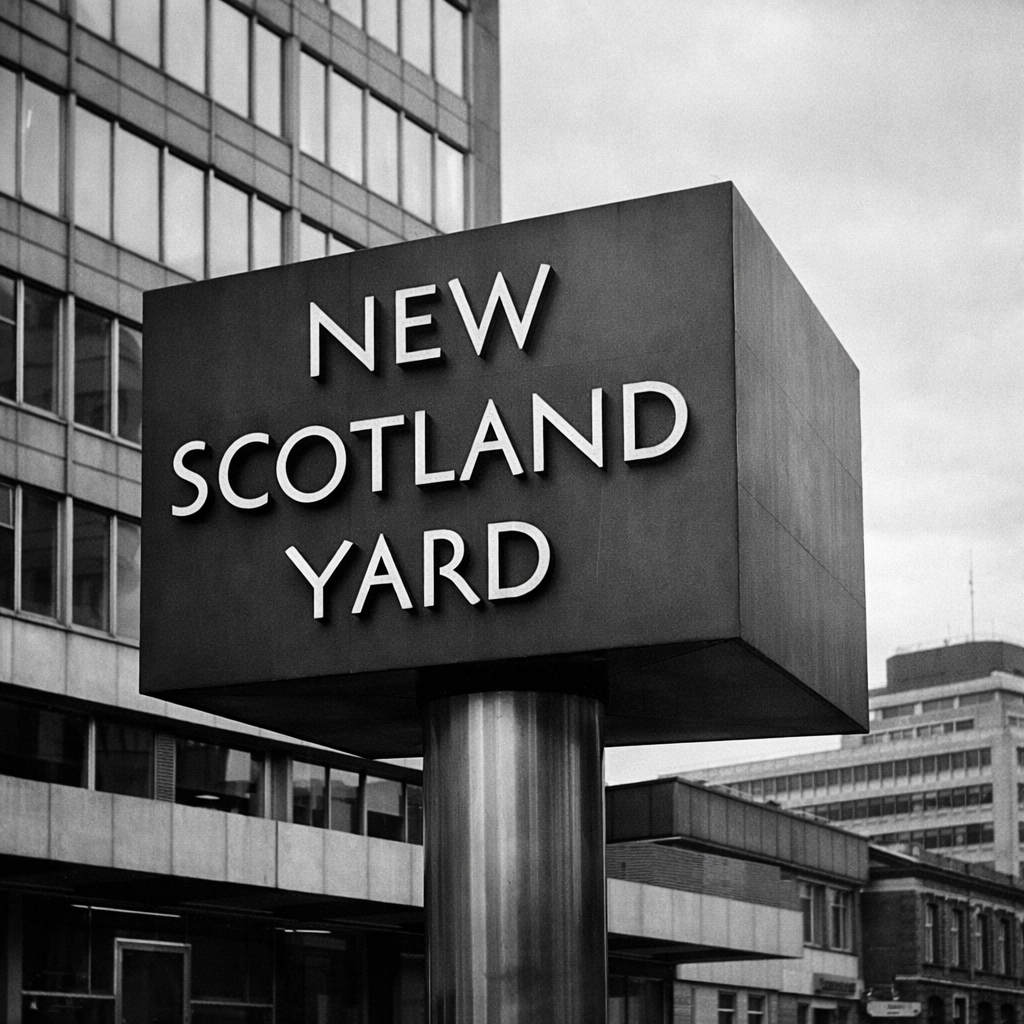
In March 1967, lorries moved through Westminster carrying more than desks and filing cabinets. They carried the paper memory of London. Criminal registers, fingerprint cards, surveillance reports, and intelligence bundles left the old Norman Shaw buildings on the Embankment and crossed to a new headquarters at 10 Broadway. It was not simply a change of address. It marked the moment when the Metropolitan Police stepped out of its Victorian skin and into the architecture of modern law enforcement.
The reorganisation of the 1960s was not an isolated reform. It was a response to urban expansion, professionalised crime, technological possibility, and internal strain. By the end of the decade, the Metropolitan Police Service had restructured its divisions, centralised its records, introduced personal radios, embraced motorised patrol, and begun integrating women into mainstream investigative roles. What emerged was recognisably the modern Met.
A Force Built for a Different Century
The Metropolitan Police had been founded in 1829, and much of its administrative culture still bore the imprint of the nineteenth century well into the 1950s[1]. Divisions were locally rooted, officers walked fixed beats, and information moved slowly through paper channels. This model relied on physical presence, proximity to police boxes, and neighbourhood stations that anchored the force within communities.
By the late 1950s, London had outgrown that framework. Population shifts, the creation of the Greater London Council, and borough reorganisation in 1965 required the redrawing of police boundaries to align with new local government structures[2]. At the same time, organised criminal groups such as the Kray twins and the Richardson gang were exploiting gaps between divisions, moving fluidly across areas that had once functioned as near autonomous territories.
The decade demanded not more of the same, but structural change.
Sir Joseph Simpson and the Logic of Centralisation
The central figure in this transformation was Sir Joseph Simpson, Commissioner from 1958 to 1968[3]. Simpson was the first Commissioner to have risen through every rank of the service, beginning as a constable. His experience of operational bottlenecks shaped his determination to modernise.
Simpson’s vision was explicit. He sought to make the Metropolitan Police the most advanced force in the world by embracing forensic science, radio communications, and administrative consolidation. The internal document detailing the reorganisation emphasises the integration of technical branches, the restructuring of divisions to match borough lines, and the consolidation of specialist squads under stronger central control[4].
This was not merely bureaucratic tidying. It was a philosophical shift from localised autonomy to strategic coordination. Crime was increasingly mobile, therefore policing had to become mobile and information driven.
Unit Beat Policing and the End of the Fixed Beat
The most visible operational reform arrived in 1967 with the introduction of Unit Beat Policing, supported by Home Office guidance and debated in Parliament[5]. The old model of a constable walking a fixed route and checking in at a police box was replaced by a layered structure.
Under Unit Beat Policing, one officer retained a foot presence within a defined “home beat” to maintain community contact. Around that core, motorised patrol units, the now familiar Panda cars, provided rapid response across wider areas. Inside the station, a “collator” gathered and analysed incoming information, creating a local intelligence node rather than a passive reporting desk[4].
The reform was driven partly by necessity. Recruitment lagged behind demand, and the force needed to stretch manpower. Personal radios, introduced widely in the mid 1960s, allowed officers to operate independently of police boxes and fixed reporting times[6]. Communication no longer required a physical tether to a station wall.
The benefits were measurable in response times and flexibility. Yet critics argued that officers enclosed in cars became less visible and less accessible. Later research into station closures and neighbourhood policing would revisit this tension between efficiency and presence[7]. The seeds of that debate were planted in this decade.
The Move to New Scotland Yard
The symbolic centrepiece of the reorganisation was the 1967 relocation of headquarters to 10 Broadway, Victoria[8]. The old Norman Shaw complex had become cramped and labyrinthine, ill suited to housing expanding forensic laboratories, record offices, and administrative departments.
The new building consolidated specialist branches on dedicated floors. Fingerprint bureaux, photographic units, and early computer facilities were brought into closer proximity. The Criminal Records Office, which had operated in dispersed form, was reorganised to support greater central control of data[4].
The logistical operation was formidable. Millions of documents required secure transfer. The reorganisation report describes strict protocols governing the handling of criminal registers and investigative files, with sworn officers supervising sensitive materials[4]. In an era marked by high profile organised crime and the aftermath of the Great Train Robbery, safeguarding records was treated as a security priority.
Centralisation also laid groundwork for future technological expansion. The Police National Computer, launched nationally in 1974, had conceptual roots in the earlier consolidation of records and crime statistics[9]. Without Broadway, the digital leap would have lacked infrastructure.
Women in the Reorganised Met
The restructuring of the 1960s coincided with a gradual transformation in the role of women within the force. For decades, Women Police Constables had been confined largely to welfare and juvenile work within a separate Women’s Department. During the 1960s, that separation began to erode.
Historical records from police museums and archives show that women increasingly entered investigative and technical roles during this period, including fingerprint bureaux and undercover vice work[10]. The centralised specialist branches at Broadway provided a framework in which technical competence could outweigh inherited gender divisions.
The full legal integration of women would follow with the Sex Discrimination Act 1975, but the administrative preconditions were laid in the previous decade. The modernisation of structure enabled the modernisation of opportunity.
Professionalisation and the Rise of Specialist Squads
Simpson’s era saw the expansion of specialist units designed to tackle emerging forms of crime. The Special Patrol Group, formed in 1961, provided a mobile reserve for serious disorder and crime hotspots[3]. The Drugs Squad and the Art and Antiques Squad reflected recognition that certain offences required concentrated expertise rather than generalist response.
This specialisation mirrored broader trends in international policing, where cooperation and technical knowledge were increasingly valued[11]. The Metropolitan Police was positioning itself not simply as a local service, but as a modern institution within a networked world of law enforcement.
Internally, this shift generated cultural friction. Veteran detectives accustomed to instinct and personal networks sometimes resisted procedural and scientific approaches. Yet the direction of travel was clear. The professional criminal required a professionalised response.
Community, Visibility, and the Efficiency Question
The closure of smaller Victorian stations formed part of the centralisation strategy. Consolidated divisional headquarters promised cost savings, improved custody facilities, and better allocation of officers[4]. From a management perspective, the case was rational.
From a community perspective, the picture was more complex. Later criminological research has suggested that physical station presence is not always directly correlated with crime levels, particularly where mobile patrol capacity is strong[7]. Yet perception matters. For residents, a shuttered station could signal withdrawal rather than reform.
The 1960s reorganisation therefore represents an early instance of what might be called the efficiency paradox. Improvements in response and intelligence can coexist with a sense of distance between police and public. This tension would resurface in debates over neighbourhood policing in later decades.
A Decade That Rebuilt the Met
By the end of the 1960s, the Metropolitan Police had redrawn its divisional map, centralised its headquarters, embraced radio and motorised patrol, strengthened specialist units, and begun integrating women into core functions. It had also laid foundations for computerisation and national data sharing.
The transformation was not accidental. It emerged from leadership, particularly under Sir Joseph Simpson, from administrative coordination with local government reforms, and from a willingness to accept that nineteenth century structures could not police a twentieth century metropolis[3].
The lorries that moved in March 1967 were therefore more than a practical convoy. They were carriers of institutional memory from one era to another. In rebuilding its architecture, the Metropolitan Police reshaped its identity. The “Peeler” of the Victorian beat became the radio linked officer of a centralised command structure. The legacy of that decade still frames the way London is policed today.
Policing & Investigation: More about this topic.
Works Cited
-
Metropolitan Police Timeline (Metropolitan Police).
Official historical overview of key developments in the force from 1829 onward, providing foundational context for structural change.
Live source | Return to citation [1] -
London Government Act 1963 and Borough Reorganisation (UK Parliament and related records).
Legislative framework that reshaped London’s boroughs, necessitating corresponding police boundary realignment.
Live source | Return to citation [2] -
Joseph Simpson (police officer) (Wikipedia).
Biographical overview of Sir Joseph Simpson’s career and reform agenda as Commissioner of the Metropolitan Police.
Live source | Return to citation [3] | Return to citation [3] | Return to citation [3] -
The Metropolitan Police Reorganisation of the 1960s (Primary document provided by author).
Detailed internal analysis of structural, logistical, and operational reforms during the 1960s, including divisional changes and the Broadway move. :contentReference[oaicite:0]{index=0}
Related archival context | Return to citation [4] -
Unit Beat Policing (Hansard, 22 June 1967) (UK Parliament).
Parliamentary debate documenting the introduction and rationale of Unit Beat Policing within the Metropolitan Police.
Live source | Return to citation [5] -
Scotland Yard History (Metropolitan Police FOI material).
Official explanation of headquarters history and developments in communications and organisational structure.
Live source | Return to citation [6] -
Police Reorganization and Crime, Evidence from Police Station Closures (Discussion Paper).
Empirical research examining the impact of station closures on crime, informing debates about centralisation and visibility.
Live source | Return to citation [7] | Return to citation [7] -
Scotland Yard (Wikipedia).
Overview of the relocation to 10 Broadway in 1967 and the architectural and administrative implications of the move.
Live source | Return to citation [8] -
Police National Computer (UK Government and historical summaries).
Background on the development of the PNC, illustrating how earlier record centralisation enabled later digital systems.
Live source | Return to citation [9] -
History of Women in Policing (Greater Manchester Police Museum).
Archival perspective on the changing role of women officers in mid twentieth century British policing.
Live source | Return to citation [10] -
Policing World Society, Historical Foundations of International Police Cooperation (Mathieu Deflem).
Scholarly analysis of professionalisation and international trends in policing during the twentieth century.
Live source | Return to citation [11]
0 Comments