
The Imperial Laboratory
The Royal Irish Constabulary
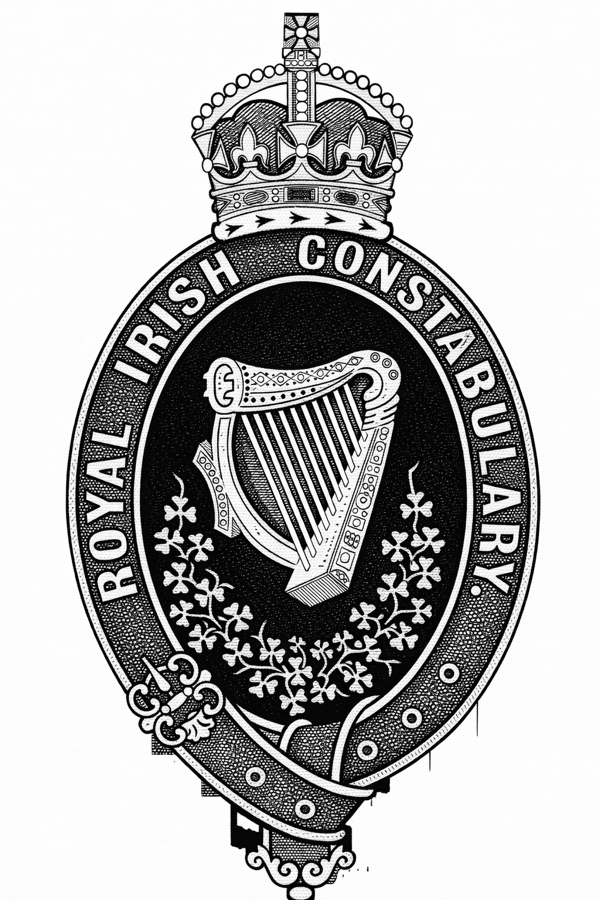
While London was developing a civilian model of policing based on patrol and public consent, a very different system was taking shape across the Irish Sea. In Ireland, British authorities created a force that looked far less like a community service and far more like a disciplined security organisation. The Royal Irish Constabulary, commonly known as the RIC, would become one of the most influential policing institutions of the nineteenth century.
To understand why this force developed so differently from the Metropolitan Police, it is necessary to look at the political and social conditions of Ireland during the period. The challenges facing the British administration there were not simply matters of urban crime. They included agrarian unrest, political agitation, and resistance to government authority. Maintaining order required a policing structure capable of operating in a far more volatile environment.
A Different Kind of Police Force
The early nineteenth century saw several attempts to impose order in rural Ireland through organised policing. Unlike England, where policing had grown out of local parish traditions, Irish policing was built from the outset as a centralised system under government control.
The constabulary model that emerged combined features of both civil policing and military organisation. Officers were armed, wore distinctive uniforms, and operated from fortified barracks distributed across the countryside. Their responsibilities included enforcing law and order, gathering information about local conditions, and responding rapidly to disturbances.
This structure reflected the political realities of the time. Ireland experienced frequent episodes of agrarian protest and secret society activity, often linked to disputes over land and tenancy. The authorities believed that maintaining order required a force capable of operating across wide rural areas while maintaining a constant presence in communities where tensions were high.
The Gendarmerie Model
In many ways the Royal Irish Constabulary resembled the gendarmerie systems used in parts of continental Europe. Officers were organised along disciplined lines, often living together in barracks and operating in coordinated patrols.
One important feature of the system was the rule of non-local service. Officers were typically posted to areas far from their home communities, reducing the risk that family or social ties might interfere with their duties. This policy reinforced the idea that the constabulary represented the authority of the state rather than the interests of local groups.
The force was also armed, a significant difference from the Metropolitan Police in London, whose officers usually carried only truncheons. In Ireland the possibility of violent confrontation meant that constables were expected to be prepared for more serious disturbances.
These characteristics gave the RIC a reputation as a disciplined and efficient organisation, though critics sometimes argued that its structure blurred the line between policing and military control.
Information and Intelligence
Beyond its patrol duties, the Royal Irish Constabulary developed an extensive system of information gathering. Officers reported regularly on local conditions, political meetings, and potential unrest.
These reports created a flow of intelligence that helped the British administration monitor developments across the island. The constabulary thus became not only an instrument of law enforcement but also a source of political information.
This emphasis on intelligence would later influence the development of specialised policing units concerned with surveillance and security. In this sense the RIC played a role in the wider evolution of modern state administration.
An Imperial Model
The Royal Irish Constabulary proved influential far beyond Ireland itself. As the British Empire expanded during the nineteenth century, colonial administrators often faced similar challenges: maintaining order in large territories with limited personnel.
The constabulary model offered a solution. Its combination of mobility, discipline, and central coordination could be adapted to many different environments.
For this reason versions of the Irish system appeared in several parts of the empire, including Canada, India, and parts of Africa. These forces shared certain common features: officers stationed in remote posts, strong hierarchical organisation, and a close relationship between policing and intelligence gathering.
Historians have sometimes described this process as an “imperial laboratory,” where methods developed in one region were tested and then exported elsewhere.
Two Models of British Policing
By the late nineteenth century Britain possessed two distinct policing traditions. In England and Wales the Metropolitan Police model emphasised civilian authority, visible patrols, and cooperation with the public. In Ireland the Royal Irish Constabulary represented a more centralised and disciplined approach shaped by political tensions.
Both systems influenced the evolution of policing across the wider world. Together they demonstrated that law enforcement could take different forms depending on the social and political conditions in which it operated.
The history of modern policing therefore cannot be understood through the London experience alone. The developments in Ireland played an equally important role in shaping the methods and institutions that later spread throughout the British Empire.
More about this topic
Research Sources
These articles draw on research from the following historical and academic sources.
0 Comments