
Rural Policing in 1960s Britain
The Blue Lamp in the Hedgerow
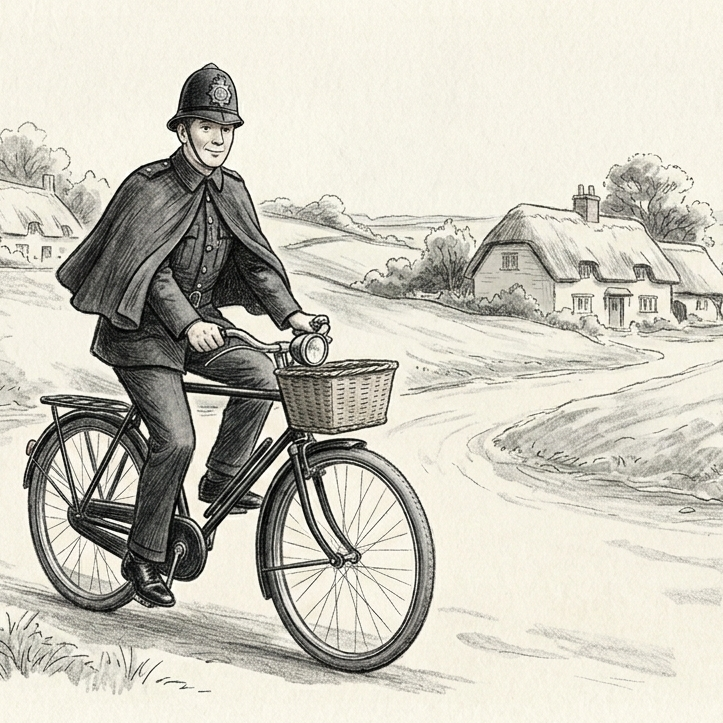
To understand the British countryside in the 1960s is to understand a landscape in the midst of a slow-motion identity crisis. While London swung to the rhythm of jazz clubs and the King’s Road, the ‘quiet edges’ of the metropolitan state—the hamlets of the Cotswolds, the fens of East Anglia, and the rugged valleys of the North—remained tethered to a Victorian sensibility of order. At the heart of this order stood the rural police house. Unlike the monolithic stations of the city, the rural police house was a domestic fortress; it was a home, an office, and a gaol all under one slate roof. The officer stationed there was not merely an agent of the law but a social arbiter, a figure whose authority was derived as much from his presence at the local cricket match as from the crown on his helmet.
The 1960s, however, introduced a creeping tension to this pastoral idyll. The ‘metropolitan state’ was no longer content to leave the fringes to their own devices. As the decade progressed, the Home Office began to view the disparate, locally-funded county forces as inefficient relics. The Police Act of 1964 loomed large, a piece of legislation that would eventually trigger the amalgamation of small forces into massive regional behemoths. For the rural officer, this was a period of profound transition. The era of the bicycle patrol was being superseded by the ‘Panda car’, and the intimate knowledge of a three-mile beat was being traded for the broad, impersonal reach of the VHF radio[1]. Yet, in the early years of the decade, the quiet edges held firm.
The Geometry of the Village Beat
The daily labour of the 1960s rural constable was dictated by the rhythm of the seasons rather than the frantic pulse of the 999 call. Policing was preventative, rooted in the philosophy of ‘policing by consent’ which found its purest expression in the village setting. A typical shift might involve the inspection of livestock movements to prevent the spread of foot-and-mouth disease, the monitoring of poaching activities in private woods, or the gentle reprimand of a local lad caught ‘scrumping’ apples. It was a world of paperwork completed by hand on oak desks, lit by the grey light of a British afternoon. The constable was the eyes and ears of the state, but he was also a neighbour. This dual identity required a delicate balance of discipline and empathy, a skill-set that was rarely taught at the training centres of Ryton-on-Dunsmore but was instead honed through years of tea-drinking and observation.
Crime in these quiet edges was often an intimate affair. Petty thefts, domestic disputes, and the occasional public house brawl following a heavy Saturday night formed the bulk of the ‘charge sheet’. However, the 1960s brought a new kind of intruder: the motorised criminal. With the expansion of the motorway network and the increasing affordability of the second-hand car, the isolation of the village was compromised. ‘Raiding’ parties from nearby cities began to target remote country houses, knowing that the local officer was likely miles away on a pedal cycle. This shift necessitated a change in tactics. The rural police started to coordinate with their urban counterparts, creating a network of intelligence that prefigured the modern National Criminal Intelligence Service. Despite these incursions, the rural officer remained a figure of immense local prestige, often serving as the unofficial clerk of the village’s moral conscience[2].
Amalgamation and the Death of Distance
By 1966, the shadow of administrative reform had lengthened. Roy Jenkins, then Home Secretary, argued that Britain could no longer afford the luxury of 117 separate police forces. The push for efficiency meant that small county constabularies—some with fewer than 200 men—were forced to merge. For the rural community, this was a bereavement. When a village lost its resident constable to a centralised station ten miles away, the link between the law and the land was severed. The ‘quiet edges’ were becoming subsumed into the administrative centre. The police house, once a beacon of security with its blue lamp, was often sold off as a private residence, its holding cell converted into a larder or a small study.
This centralisation altered the very nature of rural observation. Under the old system, a constable knew which chimney smoked at odd hours and which tractor was likely to be parked in the wrong field. Motorisation, while increasing response times for emergencies, decreased the frequency of casual interaction. The ‘Panda car’—so named for its black and white livery—became a glass bubble that separated the officer from the public. While the Home Office celebrated the technological leap, many veteran officers felt a profound sense of loss. They were no longer the guardians of a specific patch of earth; they were mobile units in a vast, regional grid. The intimate geometry of the village beat had been replaced by the cold logic of the patrol sector[3].
The Cultural Afterglow of the Rural Bobby
Even as the 1960s drew to a close and the reality of regional forces set in, the image of the village constable persisted in the British psyche. This period saw the rise of the ‘pastoral procedural’ in popular culture, perhaps most notably in the long-running series *Dixon of Dock Green*, though George Dixon was a metropolitan figure, he embodied the stolid, reliable virtues that rural communities feared were disappearing. The 1960s served as the final chapter for the individualist officer. By 1969, the amalgamation programme was largely complete, and the maps of the old county forces—Rutland, West Suffolk, the East Riding—were being folded away into history books. The rural landscape was now policed by a more professionalised, better-equipped, but undeniably more distant force.
Reflecting on this decade, one sees not just a change in uniforms or vehicles, but a change in the social contract. The village bobby was a symbol of a decentralised Britain where local problems were solved by local men with local knowledge. The shift toward the regional state was a victory for efficiency, but a defeat for the unique brand of communal surveillance that had defined English life for over a century. The blue lamp in the hedgerow had been extinguished, replaced by the flashing beacons of a patrol car speeding toward a motorway junction, leaving the quiet edges of the country to find their own way in a faster, noisier world[4].
Policing & Investigation: More about this topic.
Works Cited
- The Police Act of 1964 and its Legacy (National Archives).
Live source | Return to citation [1] - Rural Policing in the Mid-Twentieth Century (Police History Society).
Live source | Return to citation [2] - The Amalgamation of British Police Forces (Journal of British Studies).
Live source | Return to citation [3] - From Bicycles to Panda Cars: A History of Rural Patrol (Home Office Historical Records).
Live source | Return to citation [4]
0 Comments