
Can Buildings Remember?
Environmental Memory, Psychical Research, and the Idea of Recorded Trauma
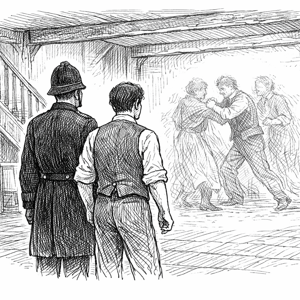
Old houses sometimes feel as though they are holding their breath. A staircase carries a tension that has nothing to do with creaking timber. A particular room feels heavy, charged, as though something once happened there and has not entirely settled. Whether one interprets this as imagination, suggestion, or something stranger, the intuition persists across cultures. Places, many believe, can remember.
The notion that buildings retain emotional imprints sits at the crossroads of folklore, nineteenth century psychical research, and modern psychology. It offers an alternative to the idea of conscious ghosts. Instead of spirits lingering with intent, it proposes that environments themselves may preserve traces of intense human experience. The question is not whether the dead are speaking, but whether the walls are.
Psychometry and the Origins of Environmental Memory
The roots of the idea can be traced to the nineteenth century concept of psychometry. In the 1840s, American physician Joseph Rodes Buchanan proposed that objects retain impressions of the events they have witnessed, impressions that sensitive individuals might read[1]. To Buchanan, materials were not inert. They were repositories of experience.
This belief found a sympathetic audience within the early Society for Psychical Research, founded in London in 1882[2]. Investigators collected accounts of apparitions tied to specific locations, particularly where trauma or sudden death had occurred. Although many members sought evidence of survival after death, others entertained the possibility that some hauntings were not spirits at all, but impressions embedded in place.
Already, a distinction was forming between intelligent agency and environmental residue. That distinction would become central to twentieth century interpretations of haunted buildings.
The Stone Tape Theory and Cultural Persistence
The idea gained modern visibility through Nigel Kneale’s 1972 BBC drama The Stone Tape, which suggested that stone structures might function like recording media[3]. According to this hypothesis, emotionally intense events imprint themselves into the physical fabric of a building and later “play back” under certain conditions.
While the Stone Tape theory lacks empirical support in physics, it remains influential because it provides a coherent framework for recurrent hauntings. If a spectral figure repeats the same movement, ignores witnesses, and shows no awareness, it behaves less like a conscious spirit and more like a recording. The theory reframes the haunting as environmental memory rather than personal survival.
Locations such as the Mermaid Inn in Rye are often cited in this context. Reports of a recurring duel in one of its rooms follow a consistent pattern and appear indifferent to observers[4]. For proponents of environmental memory, such repetition strengthens the recording hypothesis.
Yet critics note that no known physical mechanism explains how stone could store and later project sensory information. As encyclopedic treatments emphasize, the Stone Tape theory remains speculative and unproven[3]. Its value lies less in scientific validation and more in explanatory clarity.
Place, Memory, and Psychological Imprint
Modern environmental psychology offers a parallel line of inquiry. Research into place attachment demonstrates that humans invest locations with emotional meaning, particularly when significant life events occur there[5]. Memory is not stored in walls, yet our perception of space is shaped by prior experience.
In this framework, a building does not remember independently. Instead, it becomes a trigger. Sensory cues such as lighting, acoustics, or architectural features may activate deeply embedded memories in the observer. The sense that a place is “charged” may arise from the interaction between environment and psyche.
A 2022 case study on what researchers termed “Haunted People Syndrome” suggests that recurrent haunt experiences often cluster around individuals under stress, rather than locations alone[6]. Traits such as transliminality, a permeability between conscious and unconscious processing, correlate with heightened anomalous perception. In other words, some people may be more likely to read emotional residue into ambiguous environments.
Neuropsychiatric research has further proposed that sensed presences and apparitional experiences can be associated with temporal lobe instability, sleep disruption, or electromagnetic variation[7]. These findings do not dismiss the subjective reality of the experience. They suggest that environmental and neurological factors may converge to produce it.
Historical Cases of Recurrent Imprint
Historical records reveal numerous cases in which apparitions were described as repetitive and unresponsive. The SPR’s Phantasms of the Living documented crisis apparitions that conveyed information, but it also catalogued site specific manifestations that seemed indifferent to observers[2]. Investigators themselves debated whether such cases indicated survival or memory.
Folklore likewise preserves traditions of battlefields where figures re enact conflicts, or manor houses where a particular corridor always hosts the same pacing silhouette. Encyclopaedia Britannica notes that ghosts in cultural tradition often appear bound to location rather than person[8]. That binding supports the idea of environmental association.
Across accounts, a pattern emerges. The manifestation is fixed. The gestures are identical. The witness does not alter the sequence. This is not conversation. It is repetition.
Environmental Memory in Fiction and Narrative Logic
Writers have long drawn on this distinction. In one modern supernatural mystery set within an English town steeped in layered history, the idea of environmental memory becomes a central investigative tool. Two characters, rather than confronting a conscious ghost, attune themselves to the recorded impressions embedded within a troubled house. By tracing the emotional residue left in its structure, they reconstruct the sequence of events that led to present disturbances.
The scene does not rely on a speaking spirit or overt manifestation. Instead, the building itself becomes a witness. Its corridors, staircases, and enclosed spaces hold the imprint of what occurred. The investigators read that imprint, not as a séance, but as an act of interpretation. The mystery is solved not by exorcism, but by understanding.
Such narrative use of environmental memory aligns closely with the Stone Tape concept while remaining agnostic about its literal physics. The house functions as archive. The characters function as interpreters.
Between Metaphor and Mechanism
Whether buildings truly retain emotional imprints remains unproven. The Stone Tape theory lacks empirical grounding. Psychometry has not achieved scientific validation[1]. Psychological models provide plausible explanations rooted in perception and cognition.
Yet the persistence of the idea suggests that it satisfies something fundamental. Trauma leaves marks, if not in stone, then in narrative. Architecture shapes human experience, and in turn becomes inseparable from it. We remember where events occurred. We revisit them mentally. We speak of rooms as though they hold history.
Perhaps environmental memory functions best as a metaphor grounded in observation. Buildings endure beyond individual lives. They accumulate stories. Whether those stories are stored physically or reanimated psychologically, the effect is similar. A place feels inhabited by its past.
For researchers, the concept encourages caution. Not every haunting requires a spirit. Some may be echoes, loops of human intensity interacting with suggestible minds. For storytellers, it offers something equally powerful. A house need not be possessed to be alive with consequence.
In that space between mechanism and meaning, the idea of recorded buildings continues to resonate. The walls may not speak. Yet when we listen carefully, we often hear more than silence.
Paranormal Cases: More about this topic.
Works Cited
-
“Psychometry.” Encyclopaedia Britannica.
Overview of the nineteenth century concept that objects retain impressions of events, foundational to environmental memory theory.
Live source | Return to citation [1] | Return to citation [1] -
Society for Psychical Research, History and Aims.
Primary institutional history of the SPR and its early investigations into apparitions and hauntings.
Live source | Return to citation [2] | Return to citation [2] -
“The Stone Tape.” Wikipedia.
Background on Nigel Kneale’s drama that popularized the environmental recording hypothesis in modern culture.
Live source | Return to citation [3] | Return to citation [3] -
“The Mermaid Inn in Rye is among UK’s most haunted hotels.” The Argus.
Journalistic documentation of recurring apparitional reports frequently cited in discussions of residual hauntings.
Live source | Return to citation [4] -
Scannell, L., and Gifford, R. “Place Attachment.” Journal of Environmental Psychology.
Academic framework explaining emotional bonds to place and how environments trigger memory and identity.
Live source | Return to citation [5] -
Laythe, B., et al. “Case Study of Recognition Patterns in Haunted People Syndrome.” Frontiers in Psychology, 2022.
Peer reviewed study exploring psychological correlates of recurrent haunting experiences.
Live source | Return to citation [6] -
Persinger, M. A. “The Neuropsychiatry of Paranormal Experiences.” Journal of Neuropsychiatry and Clinical Neurosciences.
Examination of neurological mechanisms that may underlie sensed presences and apparitional experiences.
Live source | Return to citation [7] -
“Ghost.” Encyclopaedia Britannica.
Scholarly overview of ghost traditions and their association with specific locations in cultural history.
Live source | Return to citation [8]
0 Comments