
The Hedge Witch in Late Victorian and Edwardian Britain
Healer, Cunning Woman, and Quiet Rival to the Chemist
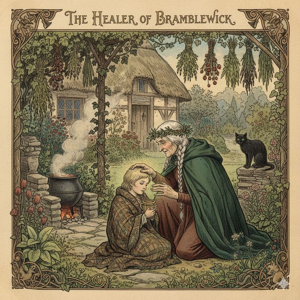
In a narrow lane at the edge of a mining village, a woman keeps jars in her cupboard. Dried foxglove hangs from a beam. Chamomile and yarrow sit in paper twists. Neighbours knock at dusk, not loudly, and not all at once. They come because a child is fevered, because a husband cannot sleep, because the doctor costs money they do not have.
By the late nineteenth century Britain had railways, telegraphs, and laboratories. It also still had hedge witches, green women, and cunning folk. They did not call themselves that in polite company. They were herbalists, wise women, bone setters, charmers, and sometimes simply “Mrs So and So up the lane.” Their role did not vanish in the Victorian and Edwardian years. It changed, adapted, and in some places quietly hardened into resistance.
From Cunning Craft to Folk Medicine
The term “cunning folk” was widely used in early modern Britain for practitioners who combined herbal knowledge, protective charms, and practical magic. By the nineteenth century, overt magical services declined in public language, but the tradition did not disappear. Historians such as Owen Davies show that cunning practices survived well into the Victorian era, often reframed as harmless folk medicine or rural custom[1]. In Cornwall, East Anglia, and parts of Yorkshire, recorded cases of wise women and charmers appear in newspapers and court reports throughout the 1800s.
The Witchcraft Act of 1735 had shifted the legal focus. It no longer treated witchcraft as real, but penalised those who claimed magical powers. By the Victorian period, prosecutions were less about fear of sorcery and more about fraud or public order[2]. This legal climate nudged hedge witches away from open spellcraft and toward healing, midwifery, and herbal consultation. They survived by sounding practical.
In many communities, especially rural ones, the hedge witch functioned as a local medical resource. Knowledge of plants such as foxglove, later understood as the source of digitalis, had deep roots in British folk practice. William Withering’s eighteenth century study of foxglove for dropsy drew explicitly on a Shropshire wise woman’s remedy[3]. By the Victorian era, this blending of folk and formal medicine was not unusual. The boundary was porous.
Medicine for Those Who Could Not Pay
In the nineteenth century, medical care was not a public entitlement. Before the creation of the National Health Service in 1948, patients paid doctors directly, joined friendly societies, or relied on charitable hospitals[4]. For the working poor, even modest fees could be prohibitive. A doctor’s visit meant lost wages and payment in cash.
Friendly societies and mutual aid clubs expanded access to some care, yet coverage was uneven and often excluded women and children. The National Insurance Act of 1911 provided limited medical benefits, but only to insured workers, not their dependents[5]. In this landscape, the hedge witch filled a gap. She might accept payment in kind, delay fees, or treat neighbours out of obligation.
Her remedies were accessible. Herbal preparations could be gathered locally. Poultices of comfrey for sprains, thyme for coughs, peppermint for stomach complaints, these were affordable and familiar. While not all were effective, many had mild pharmacological properties. Modern ethnobotanical research confirms that numerous traditional British herbs contain active compounds, even if dosage and safety varied widely[6].
For the poor, the hedge witch represented immediacy. She lived nearby. She knew the family. She did not intimidate. In an era when formal medicine could feel distant and paternalistic, that familiarity mattered.
The Dangerous Age of Patent Medicines
It is easy to imagine Victorian pharmacy as steadily improving. In reality, the nineteenth century was also the great age of patent medicines, many of which were unregulated and hazardous. Preparations containing opium, morphine, cocaine, or high alcohol content were widely sold and heavily advertised[7]. Godfrey’s Cordial, marketed to soothe infants, contained opiates and contributed to cases of fatal poisoning.
The British Medical Journal and reformers campaigned against such products, and public concern grew. The Pharmacy Act of 1868 introduced some regulation, restricting the sale of certain poisons to qualified pharmacists[8]. Yet enforcement was inconsistent, and many proprietary remedies continued to circulate.
In this context, the hedge witch’s herbalism could appear safer, at least in perception. Her remedies were recognisable plants rather than mysterious bottled elixirs. That said, herbal practice was not without risk. Foxglove, deadly nightshade, and other potent plants required careful knowledge. Misjudgment could be fatal. The difference was often one of scale and trust. A neighbour’s miscalculation felt less exploitative than a mass marketed tonic.
A Case Study: The Cunning Woman of Helston
In 1868, newspapers reported the case of a Cornish cunning woman accused of fraud after offering charms and herbal treatments to local clients. Owen Davies documents several such figures in Cornwall, where belief in folk magic persisted strongly into the late nineteenth century[9]. These practitioners were not relics of the seventeenth century. They were contemporary to railways and telephones.
What is striking in court reports is not hysteria, but negotiation. Clients sought relief from illness, lost property, or misfortune. When dissatisfied, they turned to law. The cunning woman stood at a fragile boundary between service provider and suspected deceiver. Yet the very existence of these cases reveals ongoing demand.
By the Edwardian period, open magical claims became rarer in print. Practitioners leaned further into herbalism, fortune telling, or spiritualism, which itself surged in popularity after the 1850s and again following the First World War[10]. The hedge witch adapted, sometimes rebranding, sometimes simply going quieter.
Science, Superstition, and the Psychology of Care
Victorian medicine was advancing rapidly, with germ theory gaining acceptance after the work of Louis Pasteur and Joseph Lister. Antiseptic surgery reduced mortality[11]. Hospitals improved. Yet medicine was still uneven, and bedside manner varied.
From a psychological lens, the hedge witch offered something beyond pharmacology. She provided narrative. Illness could be framed as imbalance, fright, envy, or spiritual disturbance. Modern medical anthropology suggests that meaning making plays a crucial role in healing outcomes. Patients who feel heard and understood often report better subjective recovery[12]. In a tight knit village, the wise woman’s explanation might align more closely with a family’s worldview than a doctor’s Latin diagnosis.
This does not mean the hedge witch cured tuberculosis or cholera. It means she occupied a relational space that institutional medicine had not yet fully claimed. She sat at the kitchen table. She listened. In many cases, that alone was powerful.
The Edwardian Shift
By the early twentieth century, professionalisation intensified. Medical education standards rose. Licensing tightened. Public health campaigns expanded. The 1911 National Insurance Act marked a turning point in state involvement in health care[5]. As institutional medicine strengthened, the hedge witch’s public authority narrowed.
Her role did not vanish. It migrated. Herbal knowledge moved into domestic handbooks. Midwifery became regulated. Folk remedies persisted in kitchens and allotments. The overtly magical elements retreated into folklore societies and later twentieth century revival movements.
What changed most was not belief, but legitimacy. In the Victorian era, a cunning woman could still operate semi openly in certain regions. By the Edwardian years, she was more likely to be described as eccentric, old fashioned, or quaint. Yet when money was short and children were ill, doors still opened quietly at dusk.
Between Hedge and Hospital
The hedge witch of late Victorian and Edwardian Britain stood at a threshold. She inherited centuries of cunning craft. She adapted to new laws and new science. She served those priced out of formal care. She competed, sometimes implicitly, with chemists selling opiate syrups and tonics of dubious merit.
Her story complicates any simple narrative of progress. Modern medicine saved lives on a scale unimaginable in earlier centuries. It also coexisted with dangerous patent remedies and uneven access. The hedge witch did not represent pure wisdom nor pure superstition. She represented continuity, community, and a refusal to let healing belong only to those who could afford it.
In the shadow of laboratory glass and pharmacy shelves, dried herbs still hung from beams. Not as rebellion, perhaps, but as memory. A reminder that medicine has always been both science and relationship, both compound and conversation.
The Periods: More about this topic.
Works Cited
-
Owen Davies, “Cunning-folk: Popular Magic in English History” (Hambledon and London, 2003).
Foundational academic study documenting the persistence of cunning folk into the nineteenth century.
Publisher listing | Return to citation [1]
“`
-
Witchcraft Act 1735, UK Parliament Archives.
Primary legal source explaining the shift from prosecuting witchcraft as real to prosecuting fraudulent claims.
Parliament overview | Return to citation [2] -
William Withering, “An Account of the Foxglove” (1785).
Early scientific study based on a folk remedy, illustrating the bridge between wise women and formal medicine.
Archive.org text | Return to citation [3] -
British Library, “Healthcare in Victorian Britain”.
Overview of how medical care operated before the NHS, including payment structures and charity hospitals.
British Library article | Return to citation [4] -
National Insurance Act 1911, UK National Archives.
Key legislation introducing limited state supported medical benefits for workers.
National Archives resource | Return to citation [5] | Return to citation [5] -
Royal Botanic Gardens, Kew, “Medicinal Plants”.
Scientific overview of plant based remedies and their active compounds, relevant to traditional herbalism.
Kew Gardens resource | Return to citation [6] -
British Medical Journal Archive, “Patent Medicines” (19th century reports).
Contemporary medical criticism of dangerous proprietary remedies containing opiates and alcohol.
BMJ Archive | Return to citation [7] -
Pharmacy Act 1868, UK Legislation.
Early regulatory framework restricting sale of poisons and certain drugs.
Legislation.gov.uk | Return to citation [8] -
Owen Davies, “Popular Magic: Cunning-folk in English History”.
Case material including nineteenth century Cornish cunning women and court records.
Cambridge listing | Return to citation [9] -
Alex Owen, “The Darkened Room: Women, Power and Spiritualism in Late Victorian England” (1989).
Scholarly study of spiritualism’s rise and its social context in late Victorian and Edwardian Britain.
University of Chicago Press | Return to citation [10] -
Science Museum, “Joseph Lister and Antiseptic Surgery”.
Explains the impact of antiseptic practice on nineteenth century surgical survival rates.
Science Museum article | Return to citation [11] -
Arthur Kleinman, “The Illness Narratives” (1988).
Influential work in medical anthropology exploring how meaning and narrative shape healing experiences.
Publisher listing | Return to citation [12]
“`
0 Comments