
The Doll Hospital
by Rich Odell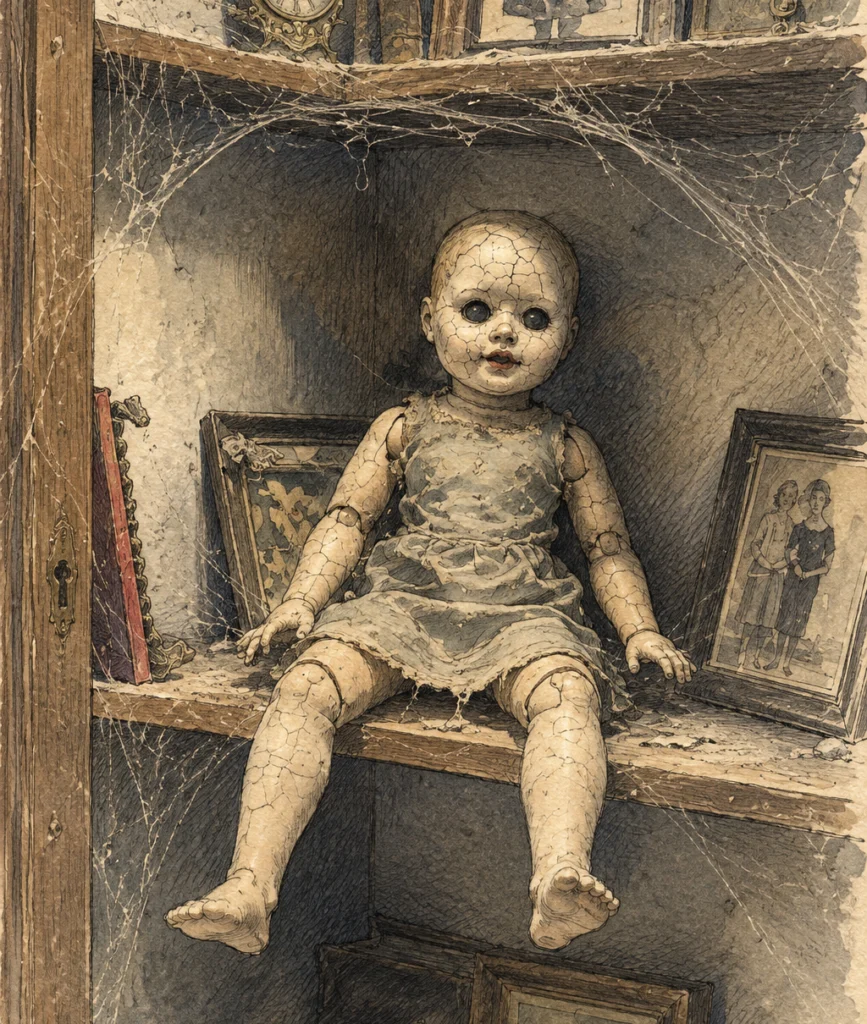
Arabella Quince had long been committed to the asylum. Her darkness was more than her remaining family could bear.
As a child, nothing in her early years betrayed it. She laughed, played, clutched her dolls like any other little girl. But beneath the surface something worked steadily, eroding every kindness it touched.
Pets were found harmed, playmates attacked, toys smashed in sudden rages. Servants bore scratches and bites. Then, at the age of ten, she set the house ablaze. Her parents died in the fire.
The doctors called it moral insanity. The neighbours called it evil. Arabella never left the asylum, but her malice lived on beyond its gates.
One of her broken dolls, the last she destroyed before the fire, had been sent to the Dolls’ Hospital. Its limbs were torn away, its painted face fractured. For years it sat half-mended. Each time the Toy Restorer tried to finish the work, it whispered to him, pressing its will into his thoughts. Fearing he was losing his mind—and that confession might see him confined as well—he hid it high in the storeroom and told no one.
There it languished. Dust settled, cobwebs spread, and still the doll waited. Never claimed, it festered in the dark for thirty years.
By 1907 the shop had changed hands many times. Odd things ruined displays, assistants grew strange, and each owner left soon after they arrived. The townsfolk said the place was haunted.
The latest proprietor, an old friend, asked Mabel Shirley for help. At first she declined, too burdened with other work. But loyalty swayed her. She agreed—much to her detriment.
It was All Hallows, when even familiar streets take on a haunted cast. Gas lamps faltered, silhouettes seemed to stir when unseen. Mabel knew the season’s tricks; trouble often rose with it.
She went alone to the shop, expecting a simple haunting. Pedestrian work.
The shop was tucked away in a narrow alley just off the high street, part of a small parade of bow-fronted premises that traded in trinkets, gifts, and crafts for passing tourists. Her friend’s place was different — a quiet little stationer’s, lined with paper, ink, and pens.
Mabel slid the key into the lock and turned it. The door gave with a reluctant groan, the bell above jangling too loud in the hush of the alley.
Inside, chaos. The floor was strewn with paper, sheets scattered as though a storm had torn through. Ink bottles lay toppled and broken, their contents seeping black across the boards. Among the wreckage, pens rattled softly where they had rolled into corners, a sound like tiny bones shifting when she stepped inside.
She shut the door behind her, the bolt sliding home with a metallic click. The air felt thick, close. Dust and ink fumes stung her throat. She crouched to lift a sheet from the floor — the page was blank, but when she turned it the faint impression of letters shimmered across it, as though some invisible hand had scrawled and then thought better of it.
The silence pressed in, heavy and expectant. Somewhere beyond the shop floor, in the dimness of the storeroom, she felt it waiting.
But this was different. This presence was not some restless ghost. It was darker, older. Primeval.
There was a narrow room between the shop floor and the storeroom, no more than a cramped passage with an indoor toilet to one side and a small kitchen tucked against the other wall. She passed through without pause, her steps echoing in the tight space, then pushed on into the back.
The storeroom was a jumble of papers, ledgers, and forgotten stock. Dust lay thick over every surface, and the air had the stagnant chill of a place too long neglected. Yet beneath the disorder another current flowed — oppressive, heavy, like the pressure before a storm.
With every step the atmosphere grew denser. The deeper she went, the more it pressed against her chest, as though the very air wanted her to turn back.
It took time to trace. She moved slowly, senses stretched taut, testing each corner, each stack of clutter for the source. At last she reached the far end, where the shadows gathered thickest. There, the presence sharpened. She could feel it, close now, coiled and waiting.
But her eyes found only darkness and dust. The thing that called to her was hidden still, unseen yet undeniable.
Her gaze settled on a cupboard sunk into the far corner, its door warped with age. The wood was swollen from damp, edges furred with dust. She tugged at the handle. It resisted, then gave with a long, splintering groan, as though protesting her intrusion.
Inside, the air was stale, trapped for decades. And there it sat.
The doll.
Perched in the middle of the shelf, its porcelain face cracked, its under garments grey with grime. Cobwebs hung from its arms, clinging like shrouds. Its glass eyes, dulled with dust, still managed to catch the light, reflecting it back without spark.
It looked soulless. Empty. A thing left too long in darkness.
Yet as Mabel’s gaze held it, the silence thickened. The stillness was not absence, but intent — as if something waited behind those lifeless eyes, watching her through the filth and ruin.
Mabel reached for the doll where it lay half-hidden in dust and cobwebs. Her fingertips brushed the cracked porcelain cheek, and at once the world shifted.
She was no longer in the storeroom. A bench stood before her, scattered with wood-shavings and scraps of cloth. A man sat hunched over it, his shoulders narrow, his back bowed from years of labour. Candlelight trembled against the curve of the doll’s face as he painted its final line.
The air was heavy with fatigue. Every breath carried the weight of resentment: a life of toil without reward, a heart soured by disappointment. The brush slipped. His hand faltered. A sigh — long, ragged — and then his body folded forward, cheek pressed against the workbench. The doll rolled from his grip, its fresh paint still wet.
The feeling clung to Mabel’s chest: unfulfilled yearning, bitterness steeped into cloth and porcelain. Then another surge broke through — sharper, crueler. Small hands seized the doll, tore at its limbs, slammed its face against the hearth. A child’s rage mingling with the craftsman’s despair, binding into something darker.
Mabel staggered back, clutching her hand to her chest. The storeroom returned, cold and silent. But the residue remained. She had touched more than a haunting. She had touched a vessel — layered with resentment, violence, and a will that had never died.
Then it struck. A fissure opened in her mind, and something slipped through. Her wards, her discipline — useless against the rush of it.
Schoolroom laughter came first: children jeering as books toppled from shelves, ink pots shattering without touch. Their taunts pressed sharp as pins into her memory. Then the ache of her teenage years — the sudden silences, the averted glances, the friends who drifted away once her strangeness grew too hard to ignore.
Her father’s absence followed, raw as the day it happened, leaving her with only the hollow echo of his steady voice. Then the Corpse Door — the screaming, the terror, the assault of the Tyrwraith. Faces of her community twisted in fear, their trust shattered.
And Sam. Always Sam. His smile, his warmth, the possibility of a life she had turned aside. The longing she still carried twisted now into punishment — the doll feeding on what she denied herself.
Every wound, every regret, every hidden desire bled open at once. Her body shuddered under the weight of it. She clutched the wall for balance, knees threatening to buckle. A cold sweat broke across her brow. For a moment, she thought she might faint, her very self drowned beneath the flood.
Her breath came shallow, her pulse ragged. Mabel pressed her palm flat against the wall, trying to steady herself. She had touched grief before, brushed against cruelty, but this was something else — two legacies wound tight together, feeding each other across decades.
“The doll isn’t haunted,” she whispered to the empty room. “It’s inhabited.”
She straightened, forcing composure, though her fingers still trembled. Normally, she could peel apart what she sensed: a life here, a death there, grief carried like a watermark. But this… this was layered, inseparable. The toy-maker’s bitterness had soaked into the doll like ink into paper, and Arabella’s fury had seized that hollow, filling it with venom.
Mabel wrapped her shawl tighter. She would tell no one what she had seen, not yet. To admit the truth was to give it strength, and even her own magic felt thin against it.
This case was different. It wasn’t a spirit to soothe or banish, nor a curse to untangle. It was a vessel, a wound made flesh in porcelain. And worse, it had survived untouched for thirty years, growing colder, hungrier, patient as stone.
For the first time in years, Mabel Shirley felt unsure. Not of her craft — but of her own strength to face what waited in the dark.
It probed again, scratching at her mind. This time she set her wards, closing her heart as Aunty Fliss had taught her. Unknown to the doll, she had already traced its name in the undercurrent: dybbuk. A parasite of the weak.
“Then see me,” she whispered, dropping her guard.
She let it in. For a heartbeat, the doll surged, confident of conquest. But then it touched the truth at her core — the thrum of Old Blood. The gift of her mother, the mark of a psychopomp. The daughter of a guide between worlds.
Power unfolded through her like wings. Not fire, not fury — but a stillness older than fear, older than death itself. She showed it who she was: one foot among the living, one already striding the shores of the dead.
The dybbuk recoiled. Its malice shrank into itself, clawing for escape. It tried to leap, to snatch a passing form — but there was none to take. No flesh, no animal, only the prison it had claimed. With a hiss of thwarted rage it collapsed back into the doll, coiling there, waiting.
Mabel exhaled, calm now, eyes cold with certainty. “Yes,” she murmured. “You recognise me.”
Only then did she draw the chain mail bag from her satchel. Each iron ring chimed softly as she opened it, a sound like quiet judgement. She lowered the doll inside and fastened the clasp. The weight dragged at her arm, but the presence no longer pressed on her mind.
The Old Blood had spoken. And the dybbuk knew its fate.
Mabel needed guidance. She had captured the dybbuk, kept it from the harm it longed to do, but she needed to know it was gone from her life for good. This was one entity she would always be wary of. The first of many, and a lesson in caution she would never forget.
Able to phase-step — to vanish and reappear in another place — she set her mind on Rattlebag Cottage and her mentor, Felicity Redhill. A hedge witch, one of the cunning folk, Fliss had trained her since she could walk. In the blink of an eye, Mabel stood at the cottage door.
She knocked once. It opened of its own accord — no surprise. Fliss always knew when she was coming. Inside, Mabel found her at the hearth, stirring the cauldron with her usual calm.
“A nasty entity troubling you?” Fliss asked without turning.
Mabel sighed. That bond, that sisterhood of the woods, meant her secrets never lasted long. “A dybbuk,” she admitted, holding up the chainmail bag.
Fliss turned, eyes narrowing. “Vicious little parasites,” she said. “Best we show it kindness. That’s what kills them — it drains the hate.”
“But how?” Mabel asked.
“The milk of human kindness. I’ve a phial in the cupboard.” Fliss crossed to a dark oak cabinet and returned with a small glass vial, cloudy white within. “Best we do this outside. Let the hate dissipate, away from the heart of the home.”
They walked a short distance into the meadow, where the air trembled with the hum of a ley line. “Good ground here,” Fliss said, feeling the flow beneath her feet.
She froze the bag with a spell, then nodded for Mabel to unclasp it. Fliss lifted the doll into her hands. Its cracked porcelain seemed almost to twitch.
“Such a shame,” she murmured. “A pretty face for darkness to hide behind.”
She pulled the cork of the phial with her teeth and poured the milky draught into the doll. It bucked violently, trembling as the warmth coursed through. Then, in a last desperate act, smoke boiled from its mouth. Two faces formed in the air — the old toy maker and Arabella Quince — both twisted in hate, both screaming.
But the cries faltered. The smoke thinned. Love had taken hold, and with it the bitterness dissolved. The images broke apart, scattering like mist in sunlight.
Fliss laid the doll on the ground and whispered a final charm. It crumbled to dust, its essence drawn down into the soil — nothing now but what feeds the earth.
As they turned back toward the cottage, Mabel broke her silence. “This one caught me out. It scared me to the bone.”
“Not the first, and not the last,” Fliss replied gently. “Remember your training. Guard your soul — but when all else fails, show the Old Blood. Walk calmly. Empty your mind. Live in the moment. Expect anything… and hold fast. That is our way.”
Mabel nodded, letting the words settle. They stepped inside the cottage, the warmth of the hearth a balm after the night air.
She eyed the cauldron still steaming by the fire. “And what’s in the pot today? Another potion?”
Fliss gave her a sidelong glance, lips twitching. “Nothing magical, dear. Just washing underwear.”
For the first time that night, Mabel laughed.
About the Author & This Work
Richard Odell is a British author of historical supernatural fiction shaped by documented folklore, historical events, unusual experiences and a strong sense of place. His stories combine historical mystery, folklore and the supernatural, while distinguishing documented history and legend from fictional invention.
- Type: Short story
- Based on: An original Mabel Shirley story drawing on historical beliefs surrounding possession, haunted objects and the dybbuk. The characters, events and investigation in The Doll Hospital are fictional.
- For readers of: historical supernatural fiction, British folklore, folk horror and occult mysteries.
- Related novel: Finding Mabel
- Related stories: The Mabel Shirley Case Files
- Explore more: Stories and novels by Richard Odell
0 Comments