
When a Village Does Not Exist
The Schoolroom Covenant: A Village Under Notice
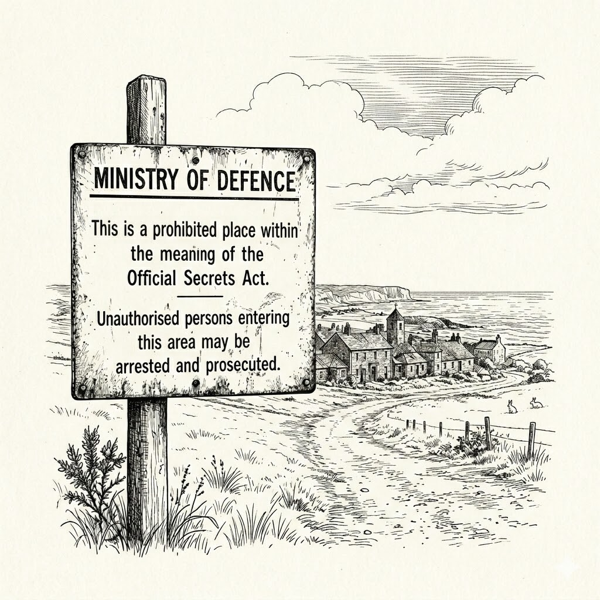
The damp chill of November 1943 had already begun to settle into the chalky soil of Salisbury Plain when the crier did his rounds. The summons to the Imber schoolroom was not unusual in itself—villages of this size thrived on such communal gatherings—but the presence of the man in the olive-drab uniform was a sharp, discordant note. As the farmers leaned against the wooden desks where their children learned their letters, they were told that their world was required for a greater purpose. The United States 101st Airborne needed a place that looked like Europe—a place with stone walls, narrow lanes, and a church tower—to rehearse the bloody street fighting that awaited them across the Channel[1].
There was no room for debate. The requisition was an act of “strategic necessity.” The villagers were given forty-seven days to dismantle lives that had taken centuries to build. In the weeks that followed, the rural rhythm of the valley was replaced by the frantic mechanical hum of the 20th century. Wagons were piled high with mattresses and heirloom clocks; livestock were driven over the ridges to neighbouring farms. Yet, the tragedy of Imber was not found in the departure, but in the belief that it was temporary. The tea sets left in the cupboards and the coal stacks in the yards were silent testimonies to a covenant between the state and the citizen—a covenant that promised a return once the “emergency” had passed[2].
As the last carts rolled out of the village in December, the silence that followed was quickly broken by the concussive thump of artillery and the rattle of machine-gun fire. Imber was no longer a home; it was a “target array.” The stone cottages, some dating back to the 17th century, were reinforced with timber and sandbags, serving as mock-ups for the French villages the American troops would soon encounter in the hedgerows of Normandy. The soldiers who trained there lived in the ruins, carving their names into the plasterwork of bedrooms where, only weeks before, local children had slept. It was a brutal, necessary transformation, but it was one that the residents believed would be undone by the inevitable victory in Europe.
The Dorset Sacrifice: The Letter on the Church Door
Sixty miles to the south, the coastal village of Tyneham in Dorset faced a similar, though perhaps more poignant, disappearance. In December 1943, its 225 residents received a letter from the War Cabinet stating that their sacrifice was a “further help towards winning the war with a good heart”[3]. The valley, owned by the Bond family for generations, was to be cleared to allow for the expansion of the Lulworth tank ranges. As the villagers prepared to leave, a note was pinned to the door of St Mary’s Church: “Please treat the church and houses with care… we will return one day and thank you for treating the village kindly.”
The social fabric of Tyneham was deeply feudal, a remnant of an England that was already vanishing elsewhere. The village was the heart of an estate, and the villagers were largely workers of the land. Their removal was not just a displacement of individuals, but the dismantling of an entire ecosystem of rural dependency. When they walked away from the stone-built cottages of “The Row,” they were walking away from a way of life that had remained largely unchanged since the Napoleonic Wars. The cliffs that had for centuries echoed with the call of gulls now reverberated with the concussive thump of Churchill tanks practicing for the invasion[4].
The Cold War Silence and the Broken Promise
As 1945 arrived and the bells of victory rang across the UK, the residents of both villages began to look towards home. But the “emergency” had not ended; it had merely changed shape. The Iron Curtain was falling, and the Ministry of Defence (MoD) realised that the British Army required permanent, large-scale training grounds for the motorised warfare of the future. The very isolation that had made Imber and Tyneham beautiful now made them expendable. The villages were kept behind barbed wire, their names removed from local council registers, and their lanes patrolled by military police. They became “ghost villages” not because of a plague or a fire, but because of a line drawn on a map in a London office[5].
In the 1950s, the bureaucratic machinery of the MoD began to formalise what had previously been an “emergency” measure. The villages were officially designated as permanent training areas. For the former residents, now scattered across the nearby towns of Warminster and Wareham, this was a betrayal of the highest order. The promise of the schoolroom and the letter from the War Cabinet were dismissed as wartime expediencies with no legal standing. The state had decided that the training of tank crews for a potential Soviet invasion outweighed the property rights of a few hundred farmers and labourers. The landscape was being militarised, and in the process, the history of the villages was being erased through neglect and target practice.
Resistance in the Ruins: The Battle for Imber
The 1960s brought a new era of activism. Former residents, led by figures like Richard Maddern, refused to let the memory of Imber fade. In 1961, a massive protest saw over 2,000 people descend upon the village during a “public opening.” They arrived in cars, on bicycles, and on foot, determined to re-occupy the homes they had been forced to leave. The images of elderly women sitting in the roofless ruins of their childhood homes were broadcast across the nation, sparking a debate about the balance between national security and civil liberties[6].
The legal battles that followed were long and bitter. The MoD argued that the Salisbury Plain was the only place in the UK capable of hosting modern armoured manoeuvres. They pointed to the “breeze-block” shells they had constructed in Imber—mock houses used to train soldiers for the urban environments of Northern Ireland—as proof that the village was now a vital military asset[7]. The courts eventually sided with the military. While the church of St Giles was preserved and the public were granted limited access on specific days of the year, the village would never again be a home. It was a fossilised relic of the mid-century, a place where the clock had stopped on a November evening in 1943.
Accidental Sanctuaries: The Vibrant Natural Order
Yet, in a strange twist of fate, the exclusion of humans has led to a flourishing of a different kind. Because the soil has not been touched by a modern plough or chemical fertiliser in eighty years, these “ghost villages” have become unintended nature reserves. Rare butterflies and orchids thrive in the gaps between artillery shells, and the silence of the abandoned streets is broken only by the call of birds that have never known the noise of a tractor or a car. The Lulworth Ranges and the Salisbury Plain now host some of the most biodiverse habitats in Western Europe, precisely because they are “danger zones”[8].
To visit Tyneham or Imber today is to experience a landscape of contradictions. You see the charred remains of a manor house alongside a sign warning of unexploded ordnance; you see a medieval baptismal font inside a church surrounded by mock-up urban combat zones. The “natural order” that has reclaimed these sites is a haunting reminder that while human history can be erased by a pen stroke, the land itself possesses a stubborn, enduring memory. These villages are no longer places of habitation, but they remain powerful symbols of a time when the British landscape was sacrificed for a future that was never quite certain.
Mid 20th Century: More about this topic.
Works Cited
- The 101st Airborne at Salisbury Plain (US Army Historical Series).
Live source | Return to citation [1] - The Imber Evacuation Records (The National Archives, UK).
Live source | Return to citation [2] - Tyneham: The Village That Died for England (Dorset County Archive).
Live source | Return to citation [3] - The Lulworth Ranges: A Historical Review (The National Archives).
Live source | Return to citation [4] - Cold War Military Land Requisition (Historic England).
Live source | Return to citation [5] - Villagers Protest at Imber (British Pathé Archive, 1961).
Live source | Return to citation [6] - Resurrecting Imber: Archaeological Relics (The Past, 2024).
Live source | Return to citation [7] - Ecological Impact of Military Exclusion Zones (Historic England Research).
Live source | Return to citation [8]
0 Comments